August 6, 2025
Horseshoe Lakes to Cartridge Lakes Basin via the Sierra High Route
1.
I wake early, a few minutes before my alarm, and blearily begin packing up. All my little things in their little bags.
There’ll be no trail today, but the walking’s easy—a mellow sidehill through open woods, over sand and fallen trees in various stages of decay. It’s perfectly still but for a few deer on the hillside above, nipping at the yellow-green grass. Sunrise just barely filters through the canopy, forming shallow orange pools of light.
2.
A mile or two from Horseshoe Lake, the woods stop suddenly at a cliff overlooking Windy Canyon. Five-thousand feet below, the Middle Fork of the Kings River rushes through its jagged gorge. Further north, a confusion of ridges rise up: Ragged Spur and the Black Divide, a million mountains I can’t name.

I follow the cliff up for a few hundred feet to a series of small, mostly dry tarns, then descend to the day’s first pass—Gray Pass, which marks the boundary between the Horseshoe and South Fork Cartridge drainages.

3.
From the pass, there’s a well-beaten path down an easy grass ramp into the South Fork. The grass is already autumn orange on top, but turns to bright summer green near the valley bottom.

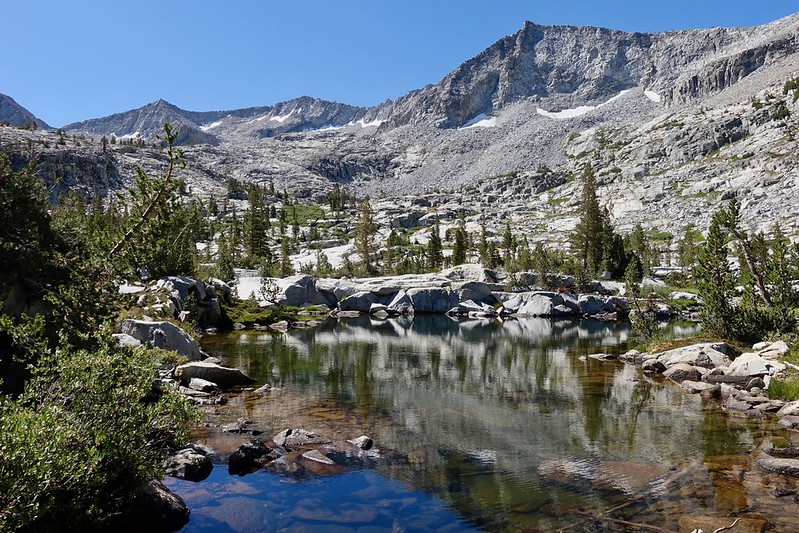
The Creek takes an unsteady course through the valley—sometimes a fast white band of rapids, sometimes something almost like a lake, mirrored and motionless. Flowers bloom along the water: paintbrush and lupine, gentian and aster.
Beyond the bottom, the valley’s a jumble of granite and grass and lightly wooded ridges. It takes some wandering, but there’s always an easy way through, east up toward White Pass.

4.
I’m weirdly tired today—I’ve been weirdly tired all trip, despite modest miles and mild terrain. Maybe this is just what it’s like to get old?
I’ve spent much of the last decade, since the JMT, feeling almost invincible, making easy miles in the mountains. I’ve always known that can’t last forever—everyone gets old—but it’s hard to feel it here, near the place where I first felt strong.
Later, I’ll learn that I was in the beginning stages of cancer.
5.
The day starts to drag as I climb a couple thousand feet up from summer and back into fall. Near the top, the dusty sand of Gray Pass and the Horseshoe Lakes is replaced by gleaming white granite.


There’s a short Class 2 scramble on the west side of White Pass, but soon enough I’m standing on the ridge, overlooking the more complex route to Red Pass. It’s apparently Class 2 or 3 if you find the right line, but I… don’t, and I make my way unsteadily through unstable rock for a few hundred feet before I hit more secure terrain.
I end up on a mellow knoll—a remnant, I think, of an ancient moraine—due east of White Pass. From here, Red Pass is a couple hundred feet below, past a broad, easy ravine. There’s even a trail for part of the way.
6.
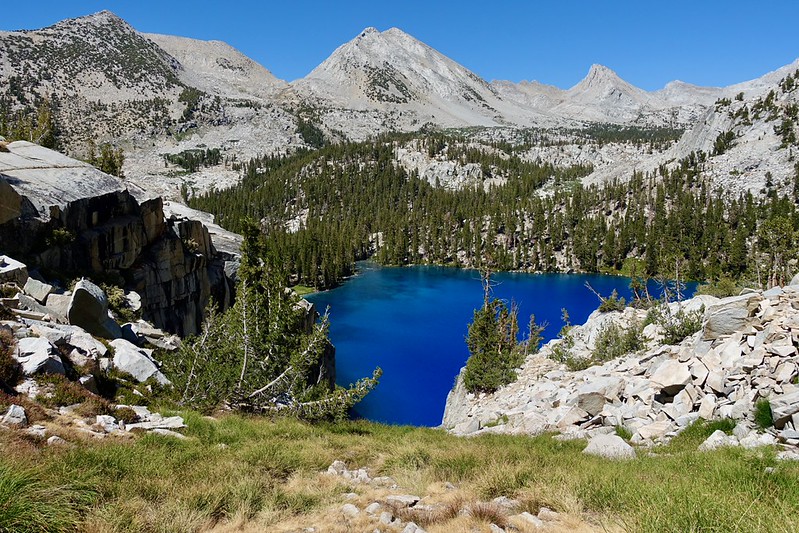
I stop for a while at Red Pass, eat a hurried lunch, and stare at the way forward, down a wide grass valley toward Marion Lake, a thousand feet below. Even from up here, the lake looks miraculous—a sort of deep, DayGlo blue pool set against the undulating red and white hills.

It’s an easy drop to the lake, through stable rock and knee-deep flowers. Small stands of whitebark pine and willow are watered by hundreds of springs that seem to come from everywhere all at once. Bees flit among the dwarf lupine.
I feel at home for the first time on this trip.


7.
The last few hundred feet to the lake are a steep drop through a deeply eroded gully. It looks impossible from the top, but there turns out to be something almost like a trail, and I find myself happily hopping from rock to rock.

I’m soon joined by a couple doing the high route, who seem to be almost running down the hill. “Do you want us to take your picture?” I say no, but immediately wish I’d said yes.
The couple speeds by, and I have the lake all to myself. Granite dust swirls in the water along the overgrown shore. The outlet—another minor fork of Cartridge Creek—roars, unseen in the trees.


8.
I think vaguely of stopping here for the night, but the bugs are bad, and so I just filter a couple liters of water and start my way through steep brush and dense woods toward the Cartridge Lakes Basin.
Trail comes and goes, interspersed with willow and rock. Several small pools, unshown on my map, are nestled at the base of a minor talus cliff. A symphony of frogs croak somewhere in the middle distance.

9.
Four hundred feet and a lot of wandering later, I arrive in the Lakes Basin proper—a series of lakes and meadows connected by wandering, rocky streams. For several decades—from early Sierra Club wanderings in the late 19th Century to construction of Mather Pass and the Golden Staircase in 1938—this was the main route through this part of the Sierra. When construction of the Muir Trail began in 1915, it went over Cartridge Pass, into this basin, then somehow down Cartridge Creek and into the Middle Fork Kings before climbing over the Goddard Divide at what was already known as Muir Pass.
Bits of old tread are still visible here and there among the rocks and wild grass, but they’re almost indistinguishable from old animal paths. Finding the old trail now feels like finding hazy old pictures of my parents from before I was born, when they were still young and half-drunk in the seventies sun.
10.
Camp tonight’s an ancient clearing at an unnamed lake nestled below the Cirque Crest. I think this was once a stock camp?—there’s a horseshoe nailed to one of the trees, rusted to the red-brown of bark—but it seemingly hasn’t been used in years.

I eat on the lake’s rocky shore, watching trout jump as the day’s last light flickers on the water. I’m tired, more tired than I should be for a day like today.

I don’t yet know how sick I am, or how sick I’ll become. Right now I just think I’m getting old. I think about my parents, carefree and young in the seventies. Years before my brother and me, years before carpools and kids’ cereal. And I think about Krista and my first time here, a decade ago, bumbling through the smoke a few miles east, carefree and young in the hazy sun.

